Access fact sheets, news and videos from Texas A&M AgriLife Research and Texas A&M AgriLife Extension Service experts at our New World screwworm web page.
New World screwworm fact sheet
Authors: Phillip Kaufman1, Sonja L. Swiger1, Andy Herring2
Texas A&M AgriLife brings together its research, teaching, and Extension expertise to help educate and provide research-backed information to Texas citizens regarding the New World screwworm.
The New World screwworm (NWS, Cochliomyia hominivorax) is a parasitic fly native to the Western Hemisphere. It lays eggs in the living tissue of fresh wounds in warm-blooded animals. The larvae (maggots) feed on the host’s flesh, causing severe wounds and often death if untreated.
The pest was eradicated in the U.S. in the 1960s. Since then, it occasionally reemerges and has resurfaced in Central America and Mexico. They are controlled only through the release of sterile males, known as the sterile insect technique (SIT). This approach, along with regular active surveillance and livestock inspections, has proven highly successful.
Attention to this parasite is crucial, as it may pose risks to livestock, companion animals, and wildlife.
Signs of New World screwworm in animals
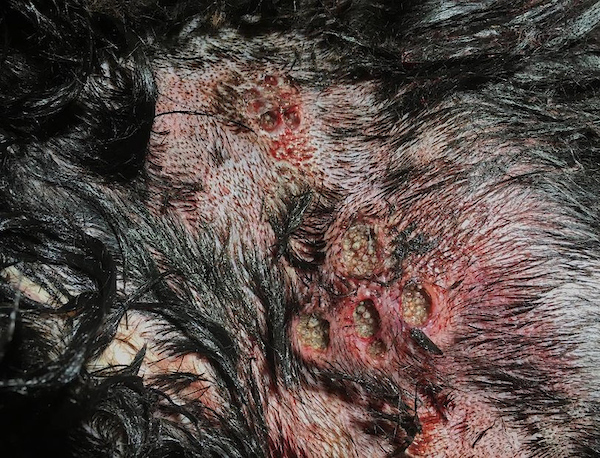
Figure 1. Screwworm infestation in dog
The name screwworm refers to the feeding behavior exhibited by the maggots as they burrow (screw) into the wound. These maggots and their feeding cause extensive damage by tearing at the hosts’ tissue with sharp mouth hooks. The wound will become larger and deeper as more and more eggs hatch and larvae feed on the living tissue. This results in serious and often deadly damage to the animal if not discovered and treated.
Continual and regular monitoring and evaluation of all animals are important for herd and flock biosecurity and health considerations. Animal owners should be alert for possible signs associated with potential infestation, including:
Foul-smelling wounds with visible maggots
Animals biting or licking at wounds
Lesions in navels, ears, dehorning or branding sites
Unusual restlessness or lethargy
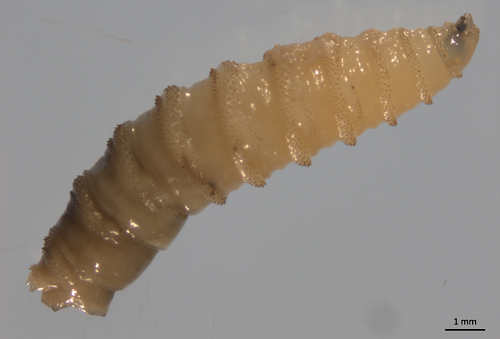
Figure 2. Screwworm larva
In the New World screwworm, the larval stage (Fig. 2) is responsible for inflicting significant injury and economic loss. These larvae inhabit the wounds of living animals, where they cause extensive tissue damage. Mature larvae can reach 17 millimeters in length (or 2/3 of an inch) and have spines that protrude from the body and wrap around in a spiral, giving them the name screwworm. Official identification of larvae is based largely on the presence or absence of dual internal breathing tubes. Confirmation of the fly identity can be determined only by a trained individual.
Identifying screwworm flies
Adult New World screwworms, Cochliomyia hominivorax, (Fig. 3) are metallic blue blow flies, have three distinct stripes that run down the top (thorax) of the fly just behind the head, and have large orange eyes. This fly resembles the closely related secondar screwworm, Cochliomyia macellaria, which is also a metallic blue blow fly with three distinct stripes, but the stripes all begin at the same point behind the head. Adult secondary screwworms do not deposit eggs on living animals, and their larvae do not infest them. Therefore, they do not pose a threat to animal health.
Figure 3. Adult New World Screwworm fly
Adult flies of interest can be photographed. Please send pictures to the Texas A&M AgriLife Extension Service at [email protected].
Report any mammals or birds (wild or domesticated) with signs of irritated behavior or head shaking, that express a smell of decay but are alive, or that show evidence of fly strike and/or the presence of fly larvae (maggots) in wounds.
Screwworm in the new world
Screwworm infestations have occurred in several regions across South America, Central America, and North America. Typical insecticide suppression of the New World screwworm is less effective than with other insect pests due to its wide host range and occurrence on wildlife. Typical fly repellant strategies, such as traps, are ineffective due to the unique feeding needs and behavior of the adult fly.
Potential control products for use in the United States
Several treatment strategies exist today and should always be used in consultation with your local veterinarian. Treatments could include:
Preventive measures: treat wounds promptly and maintain sanitation
After infestation: Topical larvicides (e.g., coumaphos, permethrin), cleaning of the wound, and removal of larvae
Please send news and media inquiries to [email protected]. World screwworm as follows:
1Professor, Department of Entomology, College of Agriculture and Life Sciences, Texas A&M University and Texas A&M AgriLife Extension 2Professor, Department of Animal Science, College of Agriculture and Life Sciences, Texas A&M University and Texas A&M AgriLife Extension
Looking for solutions in your county? Contact your local extension experts